PERIODONTAL TREATMENTS
PINK WARRIORS IN THE SINK: THE STORY BEHIND ALL THE GUM PROBLEMS
All these are warning signs of gum infections. Gums may be inflamed, and it can be mild (gingivitis) to severe (periodontitis). Visit us for a check-up to identify and treat them early.
What happens inside the mouth?
The tartar or plaque clinging onto your teeth doesn’t come off while brushing. It needs professional cleaning. If it is not removed, it travels down into the gums and eats away the bone and induces bone loss. Gum recession or periodontal pocket is formed. This gap in turn causes increased food accumulation. Food remnants harden over time and become calculus and there is repetition of cyclic changes.
How can it be diagnosed and treated?
Our periodontist will check your pocket depths and take x-rays if needed. A personalized treatment plan will be given. Scaling (superficial cleaning) is suggested for gingivitis. This is followed by root planing (deep cleaning) if needed. The use of interdental aids like dental floss and interdental brushes is encouraged to keep the interdental area clean. If gingivitis proceeds to periodontitis, invasive treatments like periodontal flap surgery may be needed.
“Maintenance is the key”. Always go for regular check-ups to keep your gums healthy and your teeth as long as possible.
These factors increase the risk of periodontitis,
- Family history of gum disease
- Hormonal changes
- Poor oral hygiene
- Diabetes, Hypertension
- Irregular dental visits
- Smoking and chewing tobacco
‘Periodontal disease doesn’t hurt, so catch them early’
Many of them ignore regular check-ups and treatment due to absense of pain. Pain is the the last symptom. Most of the damage is aldready occurred. If left untreated they cause gum recession, loose teeth, pain while chewing, and pus discharge, gum swelling, bad breath and loss of teeth. Do not ignore and visit the dentist periodically.
Periodontal treatments:
Non-surgical:
Scaling : Here the tartar formed will be removed superficially above the gum line.
Root planing :
The deposits inside the gums are removed under local anesthesia. The calculus is scraped off from the root portion of the teeth.
Surgical:
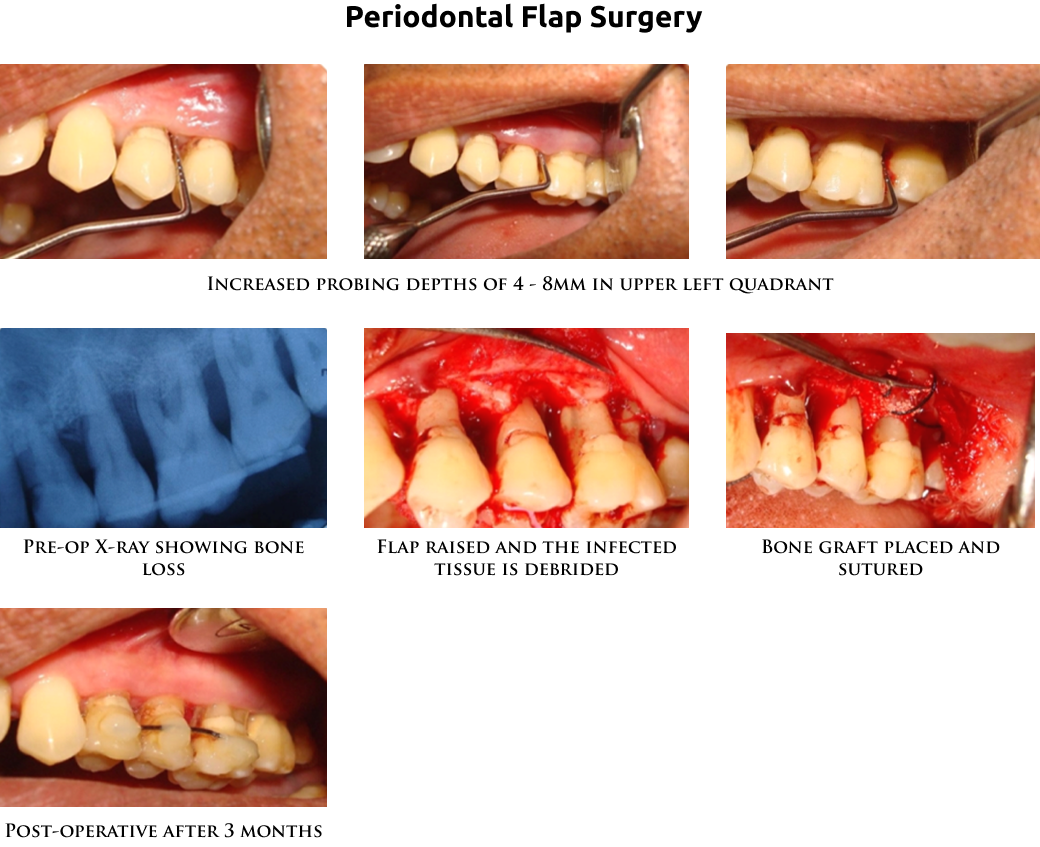
Periodontal flap surgery : It's done to reduce the pockets. The infection in the deeper portion of the gums are cleaned under local anesthesia. A cut is given, and the gums are raised above and hard deposits and infection is scraped and removed. Sometimes, in addition, bone grafts, gum grafts or guided tissue membranes may be needed to cover the root surface. The gums are sutured back. The loose gums are tightly attached to the bone after the healing period. Interdental aids need to be routinely used to keep the area clean.
Frequently Asked Questions (FAQs)
No, gum diseases do not spread from person to person.
Yes, with prompt action, the inflammation can be reduced, the damaged tissues can be restored and, we promote healing of gums. If not, gum disease worsens, and can cause tooth loss.
“Periodontal disease is a silent killer”. So don't stay quite, keep your teeth and gums clean. Do visit us often to keep your periodontal disease at bay!!